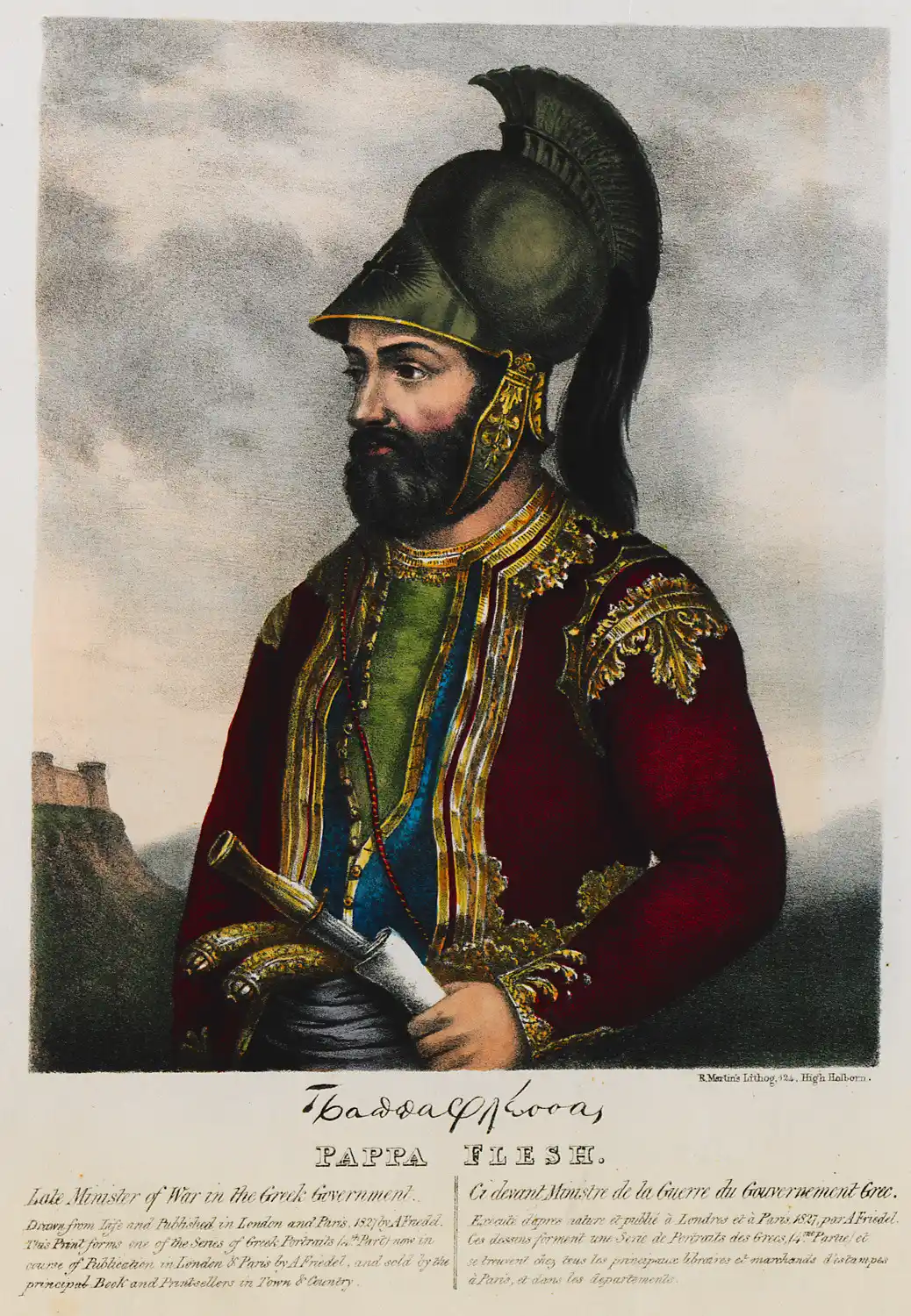
Grigorios Dikaios or Papaflessas
Grigorios Dikaios, known as Papaflessas, was a cleric who became a dynamic figure of the Greek Revolution. He was a member of the Filiki Etaireia and played a decisive role in preparing the uprising, especially in the Peloponnese. As both a political and military leader, he was prominent in critical moments of the Revolution and fell heroically in 1825 at the Battle of Maniaki.
Grigorios Dikaios, known as Papaflessas, was born in 1788 in Poliani, Messinia, into a large family. He received his early education from monks and later moved to Dimitsana to continue his studies, which he did not complete. He entered the priesthood and was ordained a monk in 1816 at the Monastery of Zoodochos Pigi in Velanidia, Messinia (Panagitsa of Velanidia). Due to a dispute with the Bishop of Monemvasia, he sought refuge at the Monastery of Saint George Rekitsa in Arcadia. Another scandalous incident endangered his safety and forced him to leave the Peloponnese. During a brief stay in Zakynthos, he came into contact with Enlightenment ideas and met Theodoros Kolokotronis.
In 1817, now known as Papaflessas, he arrived in Constantinople and, through the mediation of the Metropolitan of Derkoi, was presented to the Patriarch, who ordained him Archimandrite. There he met Christos “Anagnostaras” Papageorgiou and was initiated into the Filiki Etaireia on 21 June 1818. Papaflessas cultivated a wide network of contacts, connected with Peloponnesian merchants, and met the prominent Filikos Panagiotis Sekeris. Devoted to the Society’s cause, he received the rank of “Apostle” and began touring the Danubian Principalities to spread the revolutionary message. Although imprisoned for his activities there, he was released through the intervention of fellow Filiki members and returned to Constantinople. In a meeting with Panagiotis Anagnostopoulos, he demanded recognition as a Supreme Authority, receiving the code A.M. and the pseudonym “Harmodios.”
In October 1820, Papaflessas met Alexandros Ypsilantis and other Filiki leaders in Ismail, Bessarabia, where they discussed the Society’s operations and the course of the uprising. In early December, he set out for the Peloponnese as the Patriarch’s exarch, but in practice as Ypsilantis’s envoy. On his journey, he passed through Mytilene, Ayvalik, Hydra, and Spetses, spreading the call to arms, stirring concern among Ottoman authorities and anticipation among the Greeks of the Morea.
Papaflessas arrived in the Peloponnese in early January 1821, accompanied by his brother Nikitas Flessas. On 26 January 1821, he participated in the secret meeting at the home of Andreas Londos in Vostitsa. Despite opposition from the notables, he remained committed to the revolutionary cause. After an unsuccessful meeting with Kanellos Deligiannis in Langadia, he returned to his village, Poliani, and under the pretense of building a school, continued his work for the Filiki Etaireia.
His first revolutionary act was the liberation of Kalamata in March 1821. Initially, he followed Kolokotronis’s plan to capture Tripolitsa and fought alongside him at the Battle of Karytaina and in the defense against Dramali Pasha at Dervenakia, but he soon became his political rival. In 1823, Papaflessas was elected Minister of Internal Affairs by the Second National Assembly at Astros. During the civil war, his actions were controversial, as he undermined the Government. His stance toward Kolokotronis and the Anti-Government faction was harsh. In January 1824, the Kountouriotis administration reappointed him as Minister of Internal Affairs and Police. During the second phase of the civil war, while members of the Anti-Government faction led by Kolokotronis were imprisoned at the Monastery of Prophet Elias on Hydra, Ibrahim Pasha was campaigning in the Peloponnese.
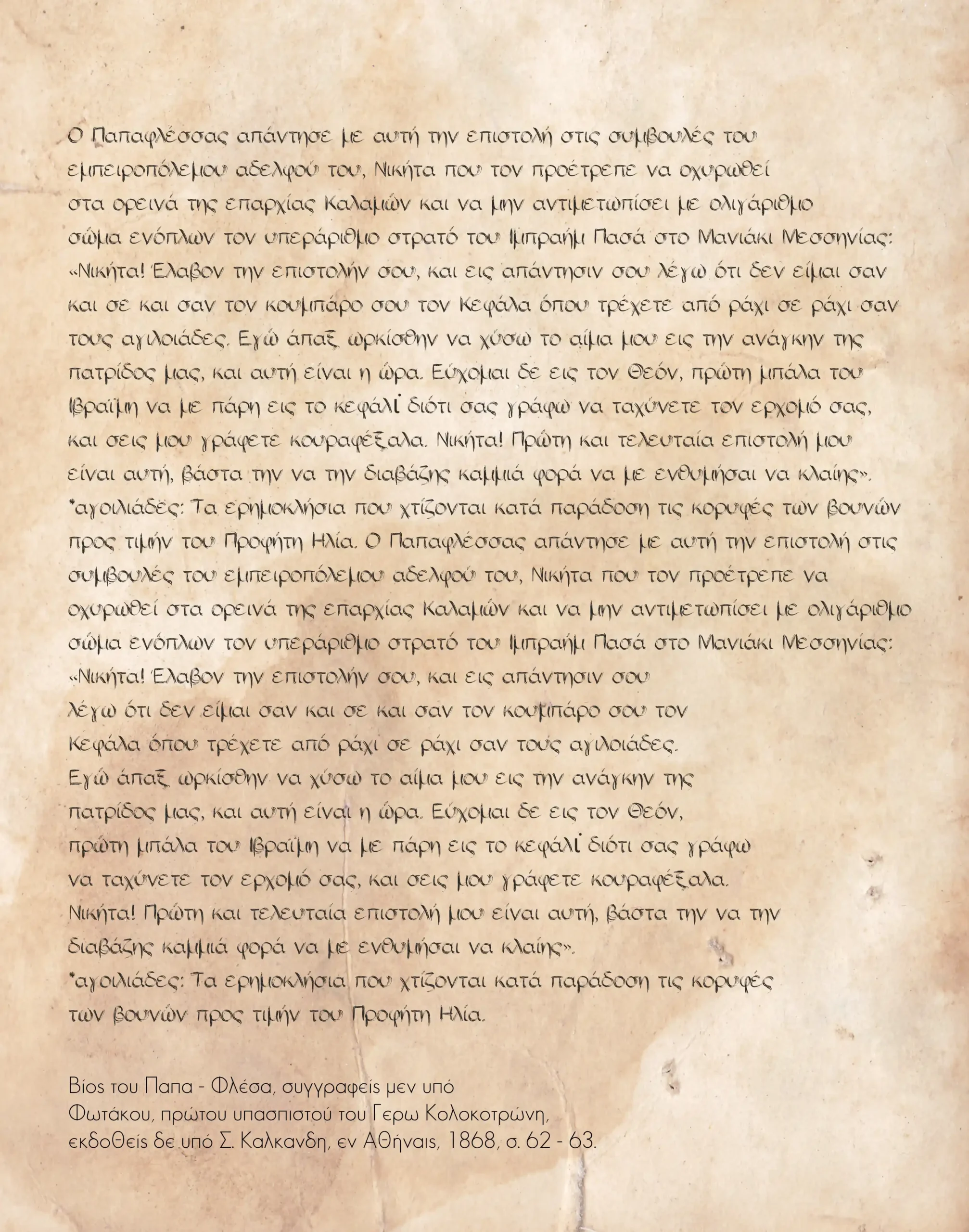
In the spring of 1825, Papaflessas undertook a campaign against Ibrahim Pasha and advocated for amnesty for the imprisoned Anti-Government fighters. The final act of his life was his heroic sacrifice at the Battle of Maniaki on 20 May 1825.