Ilias Mavromichalis
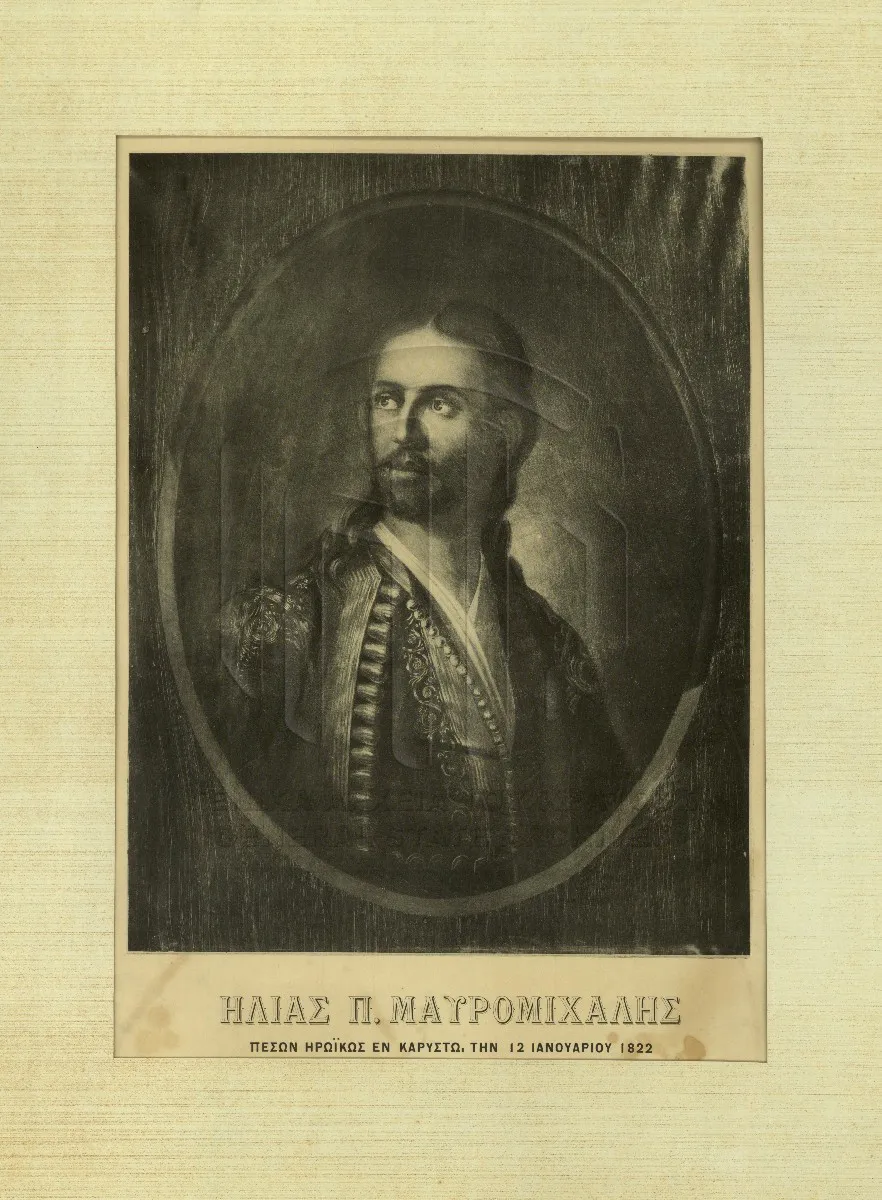
Ilias Mavromichalis, also known as “Beizantés,” was a Maniot chieftain of the Greek War of Independence and the eldest son of Petrobey Mavromichalis. He distinguished himself through his military actions in campaigns across the Peloponnese and Central Greece. His striking appearance earned him the nickname “Born of the Fairies,” while his virtues—courage, self-sacrifice, and physical strength—etched his image in collective memory as that of an ancient Spartan warrior.
Ilias Mavromichalis was born in 1795 in Limeni, Laconia. He was the eldest son of Petrobey Mavromichalis, the last Bey of Mani, and of Fotini Dimitrakakou. Known as “Beizantés” (from the Ottoman beyizade, meaning “son of the Bey”), he was also nicknamed “Born of the Fairies” due to his striking beauty.
The Mavromichalis family played an active role in preparing the Revolution in the Peloponnese. In January 1821, Ilias Mavromichalis participated in the assembly of chieftains held in Lefkada under the supervision of the Filikos Ioannis Zampelios. Among the attendees were prominent leaders from Roumeli, including Odysseas Androutsos, Georgios Varnakiotis, Georgios Tsogas, Georgios Karaiskakis, and Panourgias. They agreed that leadership of the struggle in Central Greece would be entrusted to Androutsos and Panourgias (Eastern Central Greece), and to Varnakiotis and Tsogas (Western Central Greece).
In March 1821, under the pretext of reinforcing the garrison of the Ottoman governor of Kalamata, Suleiman Agha Arnaoutoglou, Ilias Mavromichalis entered the city at the head of 150 armed Maniots. He even persuaded the governor to request additional support from Petrobey, resulting in a significant increase in the presence of armed Greeks in the region. On 23 March 1821, Greek revolutionaries encircled Kalamata and forced its surrender.
Ilias Mavromichalis aligned himself with Theodoros Kolokotronis, following his plan to capture Tripolitsa. At the Battle of Karytaina, in the pass of Saint Athanasios, he led a force of 200 Maniots. On 31 March, alongside Georgakis Plapoutas, he confronted Ottoman forces under Numana Agha at Salesi. In May, obeying Kolokotronis’s orders, he took part in the decisive Battle of Valtetsi, fighting alongside the Plapoutas brothers (the Koliopouloi), Panagiotis Giatrakos, and his relatives Kyriakoulis and Ioannis Mavromichalis against Kehayabey Mustafa.
In the summer of 1821, Ilias Mavromichalis moved toward Attica, stayed briefly in Megarida, and later joined Odysseas Androutsos in Boeotia. In June 1821, during the famous siege of the Castle of Livadeia by Ottoman forces under Omer Pasha Vryonis, led by Kiosse Mehmet Pasha and Hadji Ahmet Agha, he rushed to reinforce the besieged Greeks, boosting their morale.
In the autumn, while still in Attica, he was invited to assist his uncle Kyriakoulis Mavromichalis in the capture of the Castello Rosso (Kokkino Kastro) in Euboea. On 5 January 1822, he departed from Kalamos, Attica, heading toward Aliveri. Leading a force of 600 fighters, mostly Maniots, he assumed command of the southern Euboean forces and collaborated with key figures of the Revolution, such as Vassos Mavrovouniotis, Angelis Govios, and Nikolaos Kriezotis.
The Battle of Styra in Euboea, on 12 January 1822, would be his final engagement. As Greek forces clashed with the Ottomans, news arrived of the advance of Omer Bey of Karystos, prompting a retreat to avoid encirclement. Ilias Mavromichalis remained behind with a small force of about 60 men and eventually fortified himself in a ruined windmill with only seven fighters. According to one account, the Greeks attempted a heroic breakout and were slaughtered; another version claims they killed one another to avoid capture. His severed head was sent to Sultan Mahmud II in Constantinople.