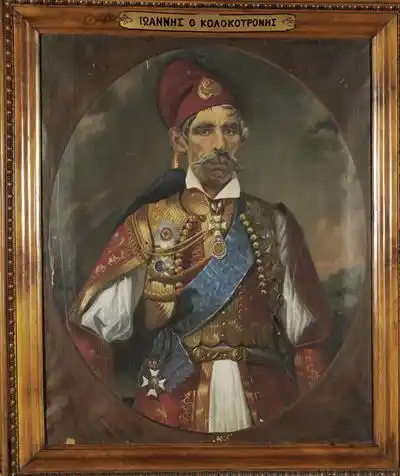
Ioannis (Gennaios) Kolokotronis
Gennaios Kolokotronis, the second-born son of Theodoros Kolokotronis, was among the youngest fighters of the 1821 Revolution. He distinguished himself by his combativeness, courage, devotion, and obedience to his father. Following the independence, he pursued a military and political career; he served as minister and later as Prime Minister under King Otto (1862). He is considered one of the emblematic figures of the first generation of politico-military leaders of the modern Greek state.
Ioannis (Gennaios) Kolokotronis was likely born in Zakynthos in 1805 and was the second-born son of Theodoros Kolokotronis and Aikaterini Karousou, daughter of the local primate/notable of Akovos. The Kolokotronis family was forced to flee the Peloponnese during the major persecution of the klephts in Morea, and thus Ioannis was raised in Zakynthos. His education was undertaken by clerical instructors, but unlike his elder brother Panos Kolokotronis, he was not particularly inclined toward learning. Prior to the outbreak of the Greek Revolution, he worked as a sailor aboard a ship from Spetses.
On March 25 1821, Ioannis Kolokotronis followed his brother Panos and crossed from Zakynthos to the bay of Pyrgi in Ileia, intending to fight alongside their father. The first major battle in which the Kolokotronis brothers participated took place in Pyrgos, Ileia, under the command of Charalambos Vilaetis, against the Lala Turks who dominated the region. Ioannis Kolokotronis was only 16 years old.
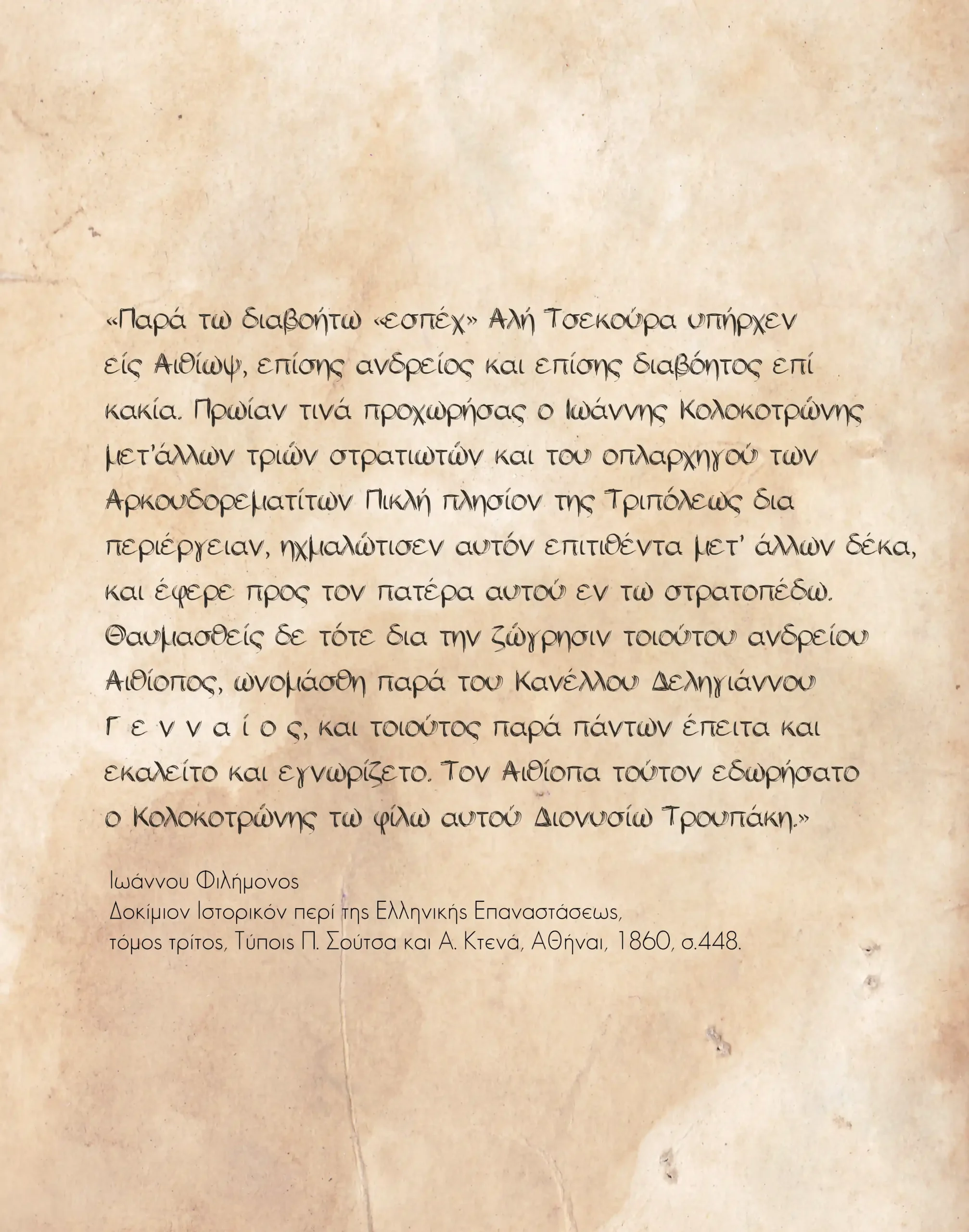
The young Ioannis Kolokotronis took part in numerous significant battles in the Peloponnese and later in Central Greece. Due to his bravery and combativeness, he earned the epithet “Gennaios” (“Valiant”), by which he became widely known. Following the Siege and Fall of Tripolitsa, he was ordered by his father to move to the Argolis region, where he participated to the siege of Nafplio and the second siege of Acrocorinth, as well as in operations for the capture of Patras. In 1822, he led a military unit composed of 450 men from Gortynia and joined the campaign in Western Greece under the command of Alexandros Mavrokordatos, but withdrew prior to the Battle of Peta due to Dramali’s invasion of the Peloponnese. Although he did not participate in the pivotal Battle of Dervenakia, he repelled remnants of the Ottoman army from the region. In October 1823, during the third siege of Acrocorinth, he was appointed by the Executive Body to lead a detachment in support of Ioannis Notaras and Staikos Staikopoulos.
During the civil strife, he supported the Anti-Government faction led by Theodoros Kolokotronis. On 21 November 1824, Gennaios assumed military command of the Kolokotronis forces following the death of his brother. While his father was imprisoned at the Monastery of Prophet Elias in Hydra, Gennaios withdrew to a monastery near Stemnitsa, Arcadia.
The landing of the Turco-Egyptian forces in the Peloponnese prompted the Kolokotronis family to reengage in the military operations of Morea. Gennaios participated as an independent captain in the battles of Trikorfa and Drampala in 1825 and fought against the forces of Mehmet Aga in Mantineia in 1826. In March 1827, as General Gennaios Kolokotronis, he led a substantial armed force in a campaign to Attica and joined the army of Georgios Karaiskakis, Commander-in-Chief of the forces of Central Greece. The death of Karaiskakis at the Battle of Analatos in Faliro in April 1827 led Gennaios to abandon the Attica front and return to the Peloponnese with his uncle Nikitaras.
In 1828, he married Fotini, daughter of Souliote chieftain Fotios Tzavellas, thereby sealing a political and military alliance between the two families. He supported the Government of Ioannis Kapodistrias and fought as an independent captain in the battles for the recapture of Western Central Greece. In 1829, he was awarded the rank of Colonel of the Light Battalions. After the assassination of Kapodistrias, Gennaios Kolokotronis was treated with hostility by the Regency and imprisoned, but was later pardoned by King Otto. In 1836, he was appointed royal adjutant and subsequently promoted to the rank of Major General.
Gennaios Kolokotronis was a supporter of the Otto regime and collaborated with Vassos Mavrovouniotis, commander of the Mountain Guard battalions, in an attempt to suppress the Revolution of September 3 1843. The failure of this endeavor led him to Naples and later to Munich. Upon his return, he engaged in politics and was appointed senator. In 1852, he led the suppression of the Maniot uprising and the arrest of the monk Christoforos Panagiotopoulos, known as “Papoulakos” (1770–1861). He served as Prime Minister of Greece from 26 May to 10 October 1862, concurrently holding the office of Minister of the Interior. The ousting of King Otto led him to leave the country and reside primarily in Italy until 1863.
On 23 May 1868, Gennaios Kolokotronis died in Athens after a prolonged battle with a terminal illness. He had seven children with Fotini Tzavella (1810–1890): Theodoros, known as “Falez,” Konstantinos, Georgitsa (wife of Petimezas), Aikaterini (wife of Rodios), Eleni (wife of Zotos), Zoitsa (wife of Manotos), and Efrosyni Kolokotronis.