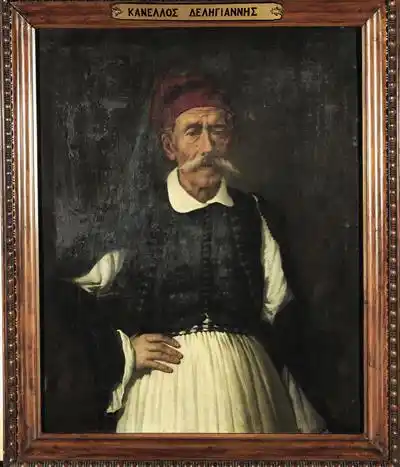
Kanellos Deligiannis
Kanellos Deligiannis was one of the prominent figures of the Greek War of Independence. A powerful notable of the Peloponnese, he was a member of the Filiki Etaireia and a capable chieftain. He participated in critical battles of the Revolution and held administrative positions. After the war, he engaged in politics and continued to serve the newly established Greek state.
Kanellos Deligiannis was born on 14 February 1780 in Langadia, Gortynia, and was the fourth son of Ioannis Papagiannopoulos (“Moragiannis”), one of the most powerful notables of the Peloponnese. He studied at the School of Dimitsana and received his early education under Bishop Akovos, Daniel. On 12 February 1816, the Ottomans ordered the beheading of his father. On 10 September 1819, Kanellos Deligiannis was initiated into the Filiki Etaireia in Tripolitsa by Panagiotis Arvalis.
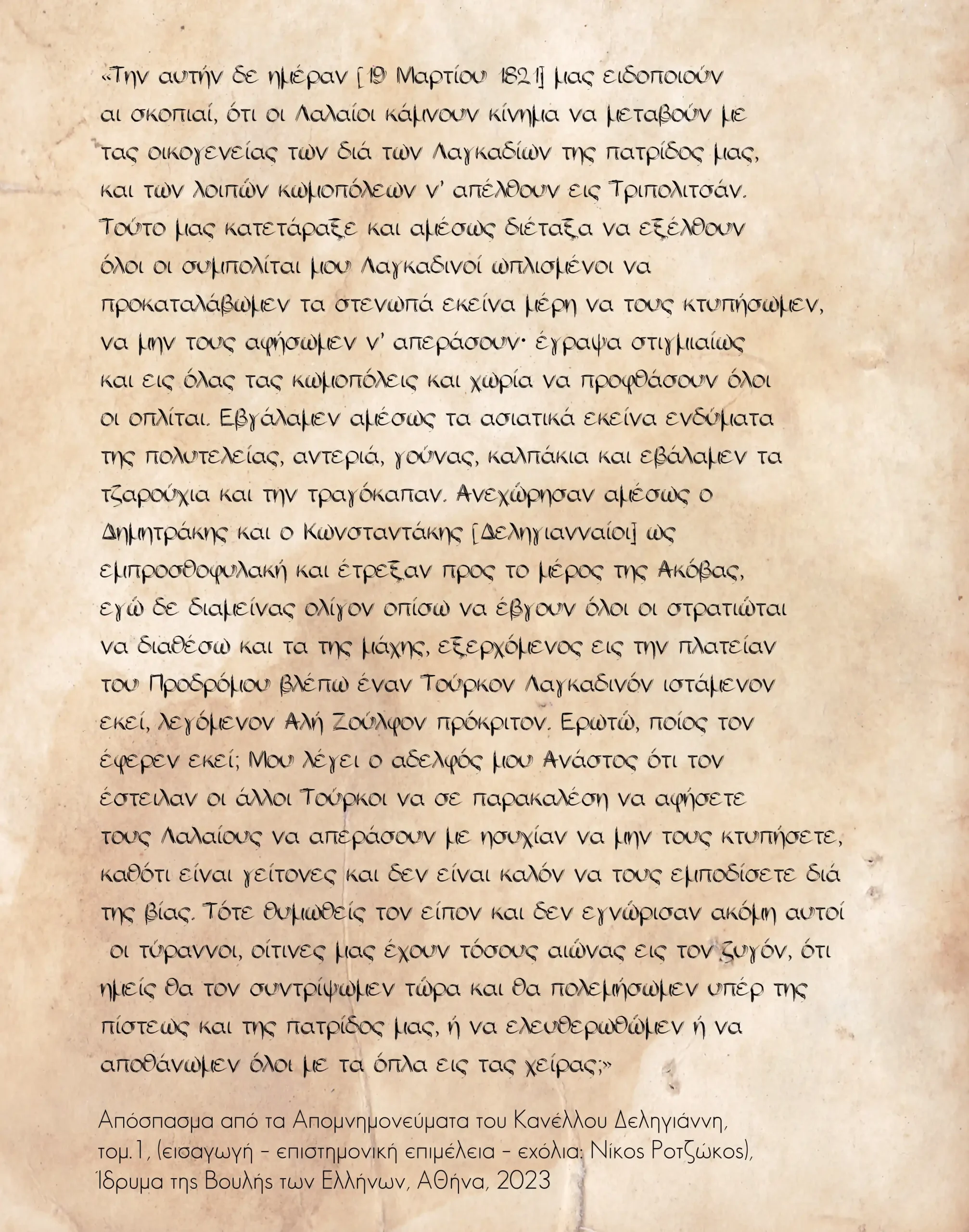
Despite initial reservations about launching the Revolution in the Peloponnese, he proclaimed the uprising in Gortynia on 23 March 1821, alongside his brothers Anagnostis and Konstantinos, and the Plapoutas brothers. He subsequently followed Theodoros Kolokotronis’s plan to capture Tripolitsa and participated in the Battle of Karytaina against Ottoman forces from the province of Fanari. In April 1821, he helped establish the military camp at Piana and later assumed the role of Commissioner of Karytaina, handing over command of the camp to Kolokotronis. Through his efforts, bakeries were established in Langadia, Stemnitsa, Dimitsana, Vervena, Magouliana, and the Akovitika villages to supply the troops, and he secured a large portion of the munitions from the gunpowder mills of Dimitsana.
Deligiannis took part in major military engagements in the Peloponnese, including the Siege and Fall of Tripolitsa, the Battle of Valtetsi, the Battle of Doliana, and the Siege of the Castle of Patras. He also contributed to the political direction of the Revolution. In May 1821, he participated in the Assembly of Kaltezes, which established the Peloponnesian Senate, of which his brother Anagnostis was a member. On 17 May 1822, the Provisional Administration awarded him the rank of General. During this period, he campaigned in Central Greece, taking part in the Battle of Peta and the First Siege of Missolonghi. In May 1823, through the engagement of his underage daughter Maria to Kolinos, the youngest son of Theodoros Kolokotronis, he sought a lasting reconciliation between the families and the formation of a strong alliance.
During the civil war, Deligiannis supported the Anti-Government faction, leading to his arrest by Panagiotis Giatrakos. He was imprisoned at the Monastery of Prophet Elias on Hydra, alongside Kolokotronis, but was released under amnesty and resumed fighting against Ibrahim Pasha in the Peloponnese. In 1827, he served as a delegate to the Third National Assembly at Troezen and clashed with Kolokotronis and Georgios Kountouriotis over the distribution of “national lands,” while opposing the appointment of Ioannis Kapodistrias as Governor. Nevertheless, he welcomed the first Governor of Greece in Nafplio in January 1828. In 1830, Deligiannis was accused of factionalism and sentenced to two years of exile on Sifnos, though the sentence was later commuted to one year of house arrest in Tripolitsa.
Following the arrival of King Otto, he remained politically active, initially supporting the “French” and later the “Russian” party. In 1834, he assisted Prosecutor Edward Masson in conducting investigations against revolutionaries accused of high treason by the Regency, among them Kolokotronis. After the adoption of the Constitution at the Third National Assembly of the Hellenes in 1844, Deligiannis allied with Dimitrakis Plapoutas and Gennaios Kolokotronis. On 20 December 1844, he was elected Speaker of the Parliament under Prime Minister Ioannis Kolettis. His term ended on 31 October 1845. In 1859, he retired with the rank of Lieutenant General and was granted a state pension in recognition of his contributions to the War of Independence.
Kanellos Deligiannis died in Athens at the age of 82, having devoted his family’s fortune to the service of the homeland.