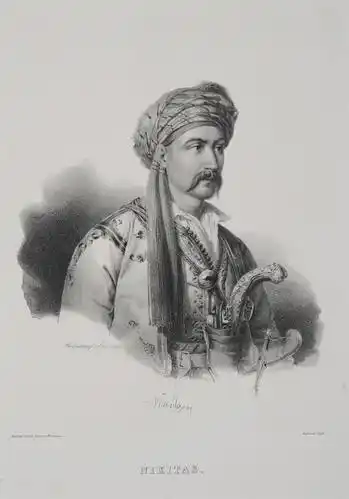
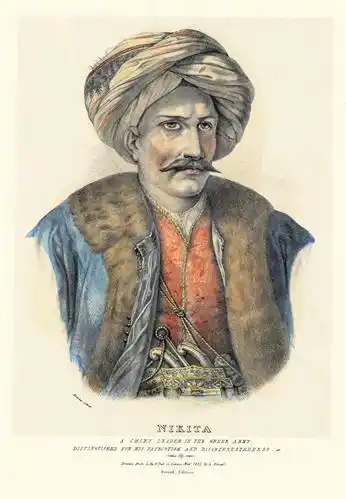
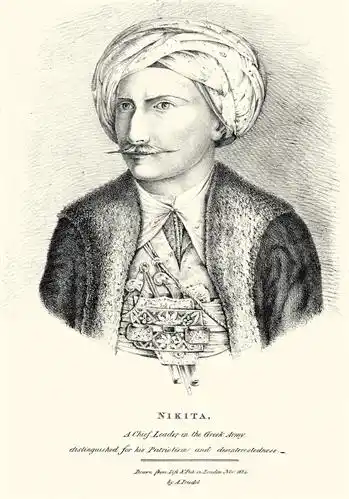
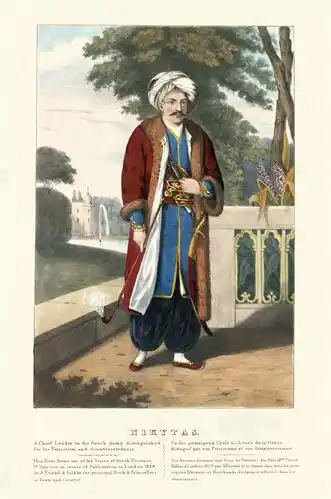
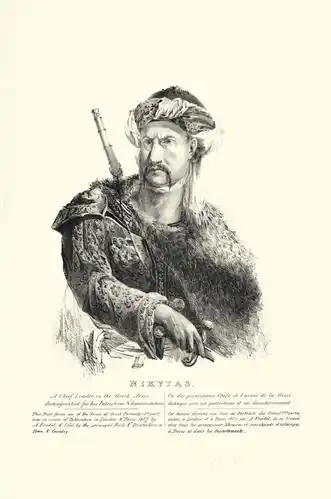
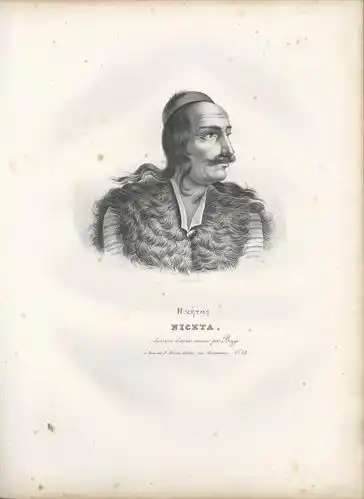
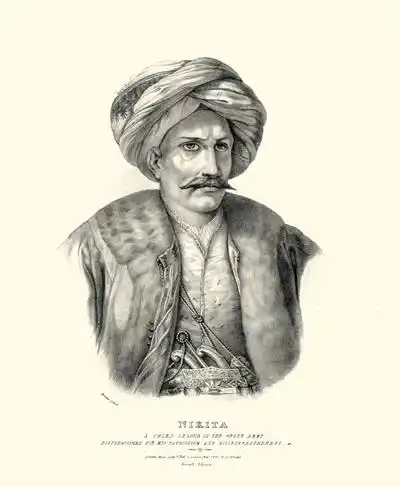
Nikitas (Nikitaras) Stamatelopoulos
Nikitas Stamatelopoulos, known as "Nikitaras the Turk-eater (Tourkofagos)," was one of the most upright and selfless chieftains of the Peloponnese, with participation in crucial military confrontations in the Peloponnese and Central Greece. He distinguished himself for his bravery, integrity, and dedication to the cause, whose contribution and ethos left an indelible mark on history.
Nikitas (Nikitaras) Stamatelopoulos was born in 1782 in Megali Anastasova (modern-day Nedousa), Arcadia. He was the son of the klepht Stamatelos Tourkolekas, originally from the village of Tourkoleka in Megalopolis, and Sofia Karousou, daughter of the notable of Akovos and sister of Aikaterini, wife of Theodoros Kolokotronis.
Stamatelos Tourkolekas collaborated with the renowned chieftain Captain Zacharias Barbitsiotis and operated primarily in the province of Leontari. Nikitas followed his father into the mountains at the age of eleven and later came under the protection of Captain Zacharias and Theodoros Kolokotronis. During the major persecution of the klephts in Morea, Tourkolekas relocated his family to Zakynthos and entered the service of the Russian and later the French army. In 1816, upon returning to the Peloponnese, he was captured and executed in Monemvasia along with his younger son Ioannis Tourkolekas and Captain Zacharias’s son, Anagnostis. Ioannis Tourkolekas is honored by the Orthodox Church as a child martyr.
In 1805, Nikitas Stamatelopoulos married Angelina, daughter of Captain Zacharias, and moved with his family to the Ionian Islands. In 1807, he served the Imperial French forces, and in 1809 he met the Irish commander Richard Church, entered his service, and followed him to Sicily and Naples. On 18 October 1818, while in Kalamata, he was initiated into the Filiki Etaireia by Elias Chrysospatis. He became an active member and worked to expand the network, targeting primarily military figures in the Peloponnese. That same year, he was involved in a bloody incident in the village of Alonistaina, Arcadia, resulting in the deaths of two Ottomans, which forced him to flee once again to the Ionian Islands.
By February 1821, he had returned to the Peloponnese. In March, together with Anagnostaras, he undertook the reception and transport of a shipment of munitions sent by the Filiki Etaireia in Smyrna, prompted by Papaflessas, to the port of Almyros in Kalamata. The presence of armed men alarmed the local Ottomans, and the Greeks, to reassure them, spread the rumor that the shipment contained olive oil and that the armed escort was a precaution against bandits. This ruse led the Ottoman governor of Kalamata, Suleiman Aga Arnaoutoglou, to request reinforcements from Mani, allowing the Greeks to encircle the city and compel its surrender. On 25 March, Nikitas departed with an armed unit toward Karytaina and, on 31 March, confronted Ottoman forces at Kalogerovouni alongside Kyriakoulis and Ioannis Mavromichalis.
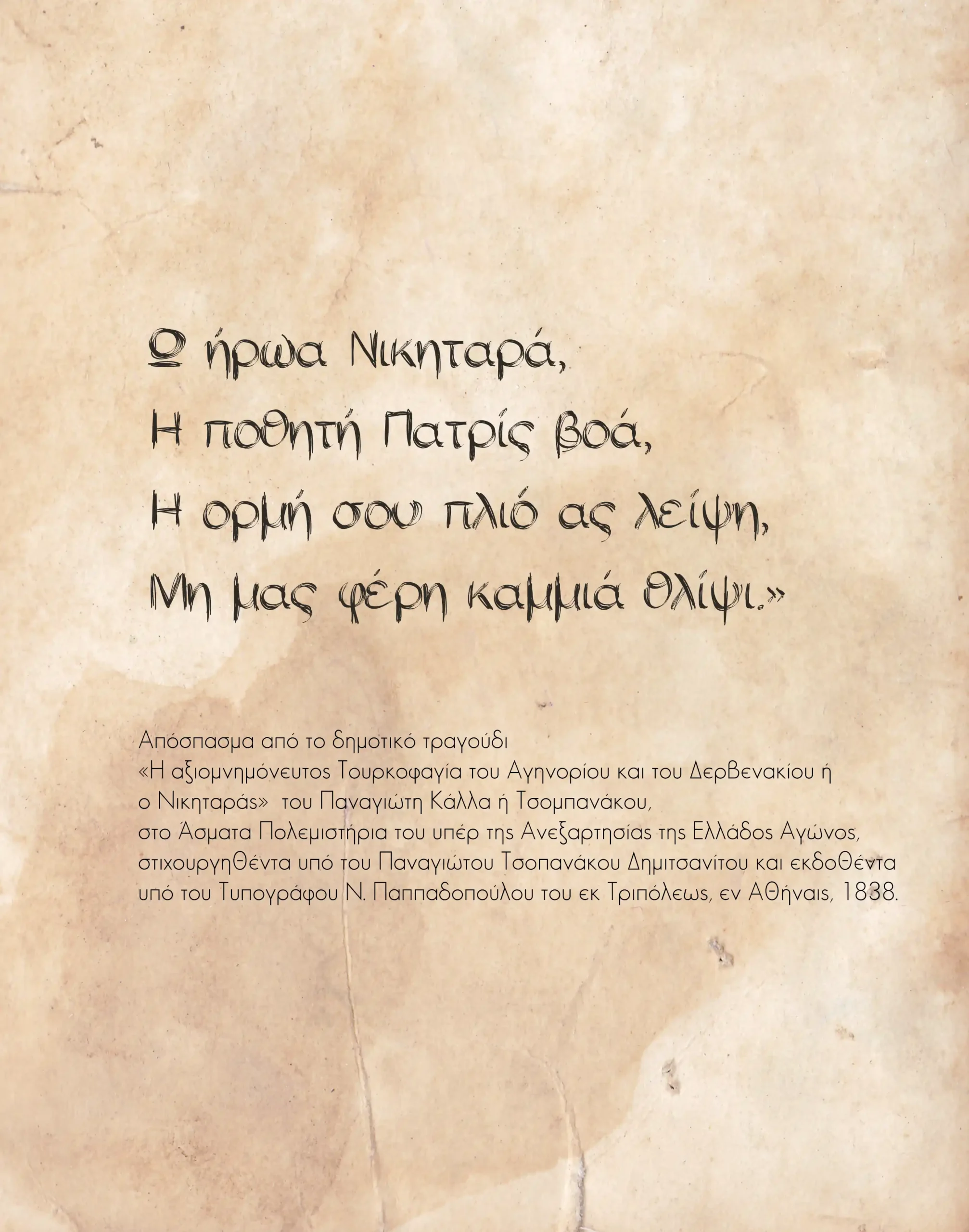
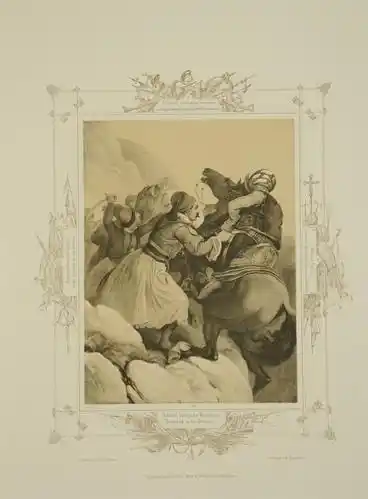
A capable and courageous fighter, he led a force of approximately 800 men in the victorious Battle of Valtetsi and demonstrated exceptional bravery in the Battle of Vervena–Doliana, where he fought tirelessly for hours. In April 1822, he joined forces with the Central Greek chieftain Giannis Dyovouniotis in the victorious Battle of Stylida, but soon returned to the Peloponnese to confront the army of Mahmud Pasha Dramali. In the Battle of Agionori, Corinthia, where he earned the epithet “Nikitaras the Turk-Eater,” he stood out for his selflessness, once again refusing to claim any share of the spoils. In August 1823, he defeated Omar Bey, Pasha of Karystos, in the victorious Battle of Kantza, Attica.
During the civil war, despite initial efforts at reconciliation, he sided with his uncle Theodoros Kolokotronis and repeatedly clashed with Government forces in Central Greece. Under the protection of Georgios Tsogas, he participated in battles in Western Central Greece and fought in the Second Siege of Missolonghi under the command of the armatolos Dimitris Makris. The release of Theodoros Kolokotronis in May 1825 marked Nikitaras’s return to the Peloponnese to confront the Egyptian forces of Ibrahim Pasha. The following year, he campaigned again in Central Greece under the command of General Georgios Karaiskakis, participating in the Battle of Arachova in autumn 1826 and the Battle of Analatos in Faliro in 1827.
Nikitaras served as garrison commander of the Third National Assembly at Troezen, which elected Ioannis Kapodistrias as the first Governor of Greece. He supported the Kapodistrian administration and fought in the battles of the Western Camp under the leadership of Richard Church. In 1829, he was appointed garrison commander of the Fourth National Assembly at Argos and served as delegate for the province of Leontari. In 1830, he was named General Commander of the Peloponnesian Militia and, two years later, General Commander of the Corinth Camp, following his command of the Messinia Camp. In September 1834, he was arrested and imprisoned at Palamidi on charges of high treason as an anti-regime figure, but was soon released. He was awarded the rank of Colonel and appointed military inspector of Messinia, but was arrested again in the summer of 1834. In December 1839, Nikitaras was accused of involvement in the pro-Russian organization Philorthodox Society, alongside Georgios Kapodistrias, brother of Ioannis Kapodistrias. He was arrested, imprisoned, and exiled to Aegina. Although eventually acquitted, the ordeal severely affected his health.
Nikitas Stamatelopoulos spent his final years as a resident of a poorhouse in Piraeus and died neglected, ill, and nearly blind in 1849. He was an honest, brave, modest, and selfless revolutionary, whose contribution and moral integrity left an indelible mark on the history of the Greek War of Independence.