
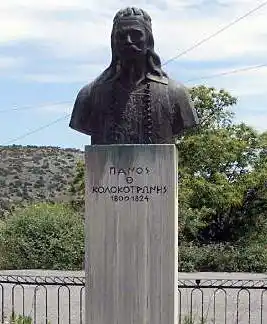
Panagiotis (Panos) Kolokotronis
Panos Kolokotronis, the eldest son of Theodoros Kolokotronis, was a capable and educated fighter of the Greek War of Independence. At the outbreak of the Revolution, he rushed to the Peloponnese and served as an officer under Theodoros Kolokotronis, participating in key military operations of the period.
Panagiotis (Panos) Kolokotronis was born in 1798 in the village of Akovos, Arcadia, and was the eldest son of Theodoros Kolokotronis and Aikaterini Karousou, daughter of the local primate/notable of Akovos. The Kolokotronis family was forced to flee the Peloponnese during the major persecution of the klephts in Morea, and thus Panos was raised in the Ionian Islands.
Panos Kolokotronis was intellectually inclined and received a notable education. In Zakynthos, he acquired his first literacy skills and studied under Antonios Martelaos. He later attended the Academy of Corfu. He excelled in mathematics, had a strong command of Ancient Greek, and spoke Italian fluently, with some knowledge of French. Among the revolutionaries, Panos stood out for his education and noble character. He is considered one of the most educated Greeks to have fought in the War of Independence.
On 20 December 1818, while in Zakynthos, he was initiated into the Filiki Etaireia (Society of Friends) by his father and participated in the preparations for the uprising. On 25 March 1821, Panos and his younger brother Ioannis (Gennaios) Kolokotronis crossed from Zakynthos to the region of Ileia to join their father in battle. Their first major engagement occurred in Pyrgos, Ileias, in April, under the command of Charalambos Vilaetis, where they confronted the Lala Turks who dominated the area.
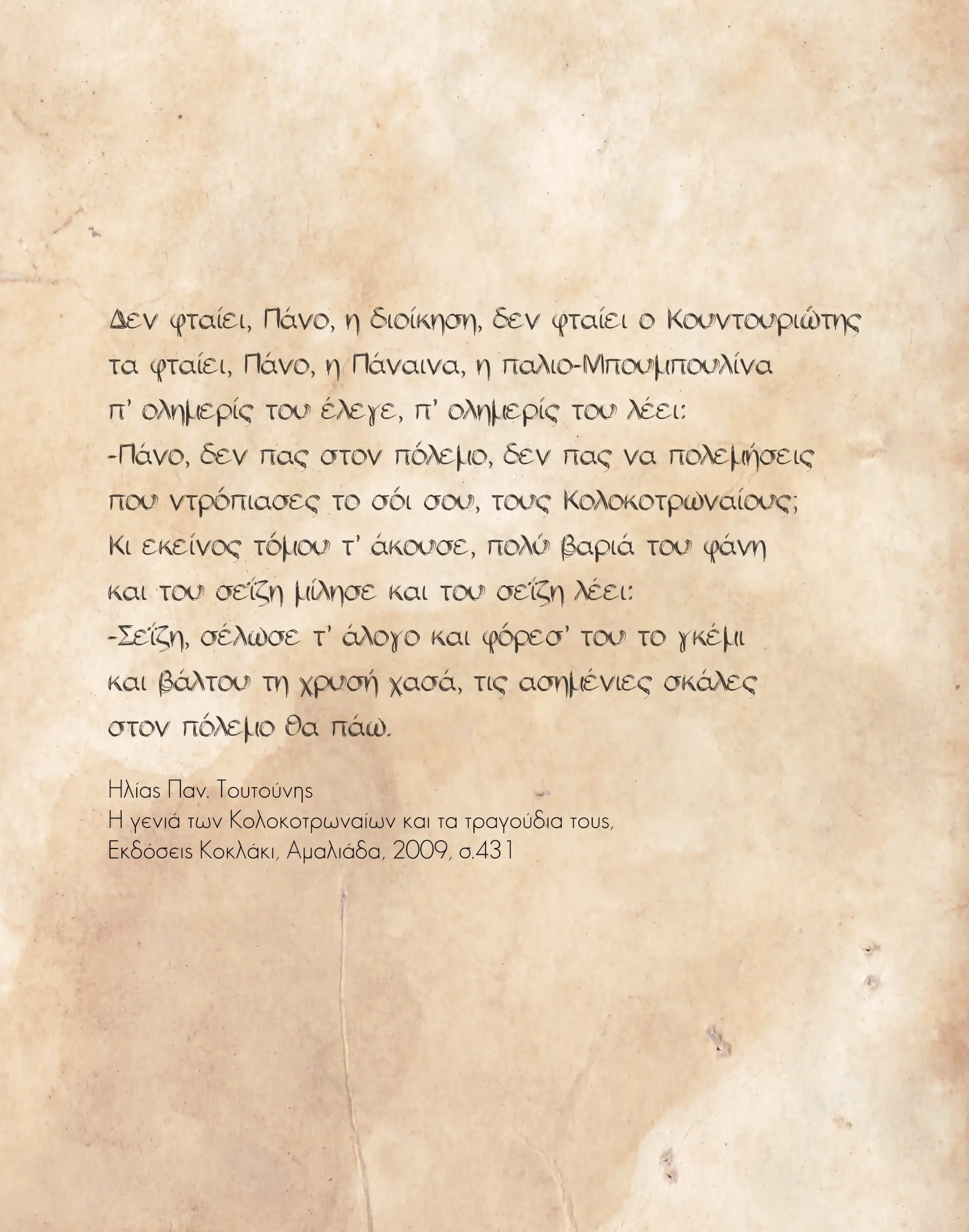
During the early years of the Revolution, Panos Kolokotronis assumed significant responsibilities and distinguished himself in key battles. He was initially appointed recruitment officer for the province of Karytaina and was concurrently tasked with overseeing the military camps of Valtetsi and Trikorfa. Following the Siege and Fall of Tripolitsa, he was appointed by Theodoros Kolokotronis Civil Governor of Tripolitsa, and the Peloponnesian Senate conferred upon him the rank of Chiliarch (commander of a thousand). He fought valiantly at the Battle of Valtetsi, participated in numerous military operations in the Argolis region, and confronted the army of Dramali Pasha at Dervenakia in July 1822. In June 1823, the Provisional Administration awarded him the rank of General and appointed him Garrison Commander of Nafplio. That same year, Panos Kolokotronis married Eleni Boubouli, daughter of the renowned naval commander Laskarina Bouboulina, thereby sealing the alliance between the two families.
During the first phase of the Greek civil conflict, Panos Kolokotronis staunchly defended the Anti-Government faction led by Theodoros Kolokotronis. In 1824, under orders from the Government, Nafplio was besieged. Panos capitulated and, on 7 June 1824, was compelled to surrender the fortress of Nafplio to Government forces led by Andreas Zaimis and Andreas Londos, while simultaneously assuming responsibility for the siege of Patras.
After the dissolution of the siege of Patras, Panos Kolokotronis, alongside Kanellos Deligiannis, was dispatched to reinforce the military units of the Ntredes in the region of Trifylia, Messenia, against whom Government forces had launched a campaign under the leadership of Papaflessas and Ioannis Makrygiannis. Subsequently, Panos was ordered to return to Tripolitsa to join the forces of his father and brother, who had meanwhile captured several villages south of the city. During his return, he received news of the capture of the revolutionary Staikos Staikopoulos and hastened to liberate him by besieging the armed unit of Vassos Mavrovouniotis in the area of Vouno, Arcadia. The siege ended inconclusively, as Panos departed to meet his brother Gennaios in the nearby village of Kamari. His absence allowed his already politically divided troops to retreat and, in some cases, desert.
As a result, Panos Kolokotronis and his three aides-de-camp—Theodoros Rigopoulos, Giannis Vankiotis, and Anastos Siamaranis—headed toward Theodoros Kolokotronis’s camp in Silimna, Arcadia. En route, however, they fell into an ambush set by Government forces between the villages of Thana and Pallantio (Besiri), Arcadia. Soldiers under Vassos Mavrovouniotis opened fire on Kolokotronis. On 13 November 1824, Panos Kolokotronis was fatally shot in the head. His lifeless body was looted and stripped by men under Kotzos Voulgaris, who had been hiding in the area.
Theodoros Kolokotronis ordered the transport of Panos’s remains to the camp in Silimna for burial. His death was a devastating blow to the “Old Man of Morea.” The contribution of this capable and educated fighter would have been invaluable both to the War for Independence and to the shaping of the nascent Greek state.