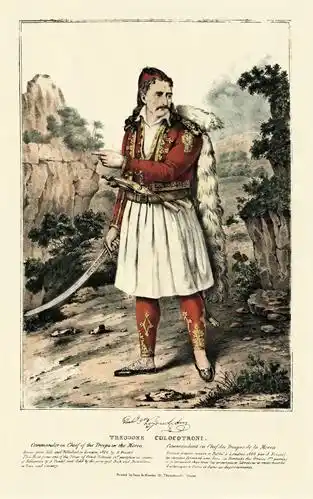
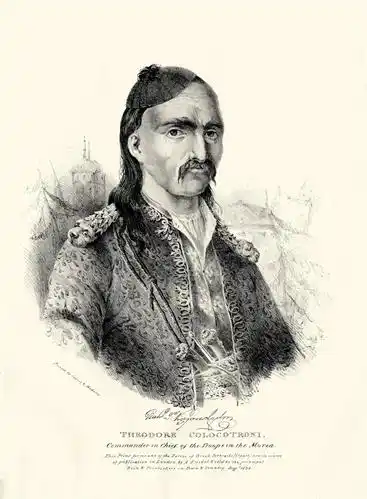
Theodoros Kolokotronis
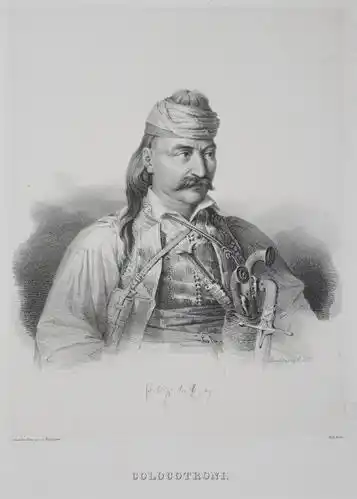
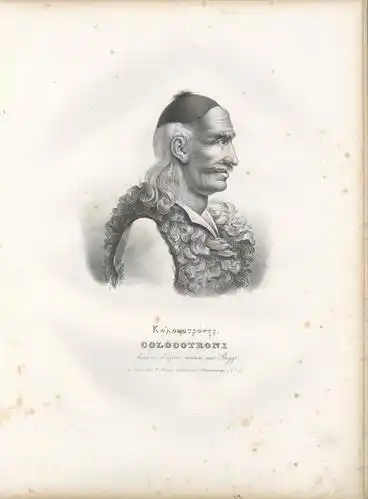
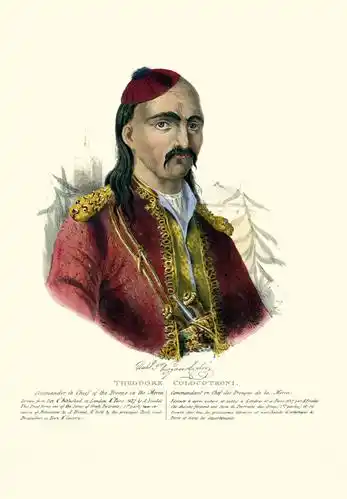
Theodoros Kolokotronis is a central figure of the Struggle for Independence. He was distinguished for his strategic ability, perceptiveness, and flexibility during the organization of the Revolution in the Peloponnese. He is considered an emblematic personality of modern Greek history.
Theodoros Kolokotronis was born on April 3, 1770, on Easter Monday, in Ramovouni, of Messenia, at the location "Roupaki". He was the son of the famous klepht Konstandis Kolokotronis and Zambeta (Zambia), née Kotsaki. Shortly after his father's death, in 1780 in the tower of Kastanitsa, his mother moved the family from Milia, Messenia, to her paternal home in Alonistaina, Arcadia. Theodoros and his siblings were placed under the protection of their uncle, Anagnostis Kolokotronis, and in 1785 they moved to the Arcadian village Akovos, Megalopoli. Theodoros Kolokotronis was appointed armatolos in the province of Leontari and in 1790 he married Aikaterini Karousou, daughter of the Primate (Proestos) of Akovos.
He states in his memoirs: "(…) I built houses, took an olive grove as dowry, a vineyard, I became a landord and I also guarded the Vilayet (province); we always lived with the rifle. The Turks envied us and wanted to kill us, but they could not, because the place was isolated, and they fought (to destroy us) at every opportunity. (…) The Turks destroyed all our belongings, and gave orders: to destroy us wherever we were heard of. I remained with twelve members of the Kolokotroni family, younger in age, and we went to Mani, we left our families and then we returned, we rebelled openly, we gathered soldiers, sometimes 60, sometimes fewer. We remained klephts for 2 years; then they saw that they could do nothing to us and they placed us again as armatoloi. I held Leontari and Karytaina, I was an armatolos for 4.5 years. (…) When we were armatoloi, our children were in Mani, in Kastania (…). After six years, I took my children to a village, Granitza near Kalamata, because it was better for our animal husbandry (…)".
During the great persecution of the klephts of the Peloponnese, Theodoros Kolokotronis moved his family to Zakynthos for safety and joined, for a short period, the service of the Russians who had settled in the Ionian Islands within the framework of the establishment of the Septinsular Republic. Soon, however, he returned to the klephtouria of the Peloponnese along with his brother Giannis Kolokotronis.
"To be a klepht was a boast; he would say: I am a klepht, and the blessing of a child's parents was for him to become a klepht.".
In May 1806, he found himself back in Zakynthos and subsequently, in consultation with Anagnostaras and the Petmeza family, he took command as captain of a ship (a scebec with ten cannons) and went to Corfu to obtain permission to fight the Ottomans alongside the Russians. After the Treaty of Tilsit (1807) and the cession of the Ionian Islands to Napoleon I, Kolokotronis fought the Ottomans in the Northern Aegean. He passed through Mount Athos (Agion Oros) and Skiathos before returning to Mani with Zakynthos as his final destination. During this period, he was particularly active and participated in various conflicts. Furthermore, he came into contact with the French General François-Xavier Donzelot in Corfu, aiming to organize a military corps and prepare an attack against the Ottomans, but the plan did not proceed due to the British capture of Zakynthos. From September to January 1809, he stayed in Lefkada. In May 1810, he was promoted to maggiore (major) of the English navy, and stayed for a short time in Zakynthos. From his service in the Greek Light Infantry of the English army, he fought the French until 1816 and gained valuable military experience.
"I was 50 years old when I joined the revolution.".
Theodoros Kolokotronis was initiated into the Filiki Etaireia (Society of Friends) on December 1, 1818, at the Holy Church of Agios Georgios in Zakynthos, by Christos Papageorgiou, known as "Anagnostaras." He himself claims in his Memoirs that he initiated many in Zakynthos and Cephalonia, including several captains of Spetsiot and Hydraean ships. In 1819, he passed through Corfu, feigning a request for outstanding wages from the British administration, with the ultimate goal of meeting Ioannis Kapodistrias who was on the island. On January 6, 1821, Theodoros Kolokotronis returned to the Peloponnese. In June 1820, Filiki Etaireia had placed him in charge of the Peloponnesian forces, recognizing his experience and leadership skills, which would be highlighted in the significant battles of Karytaina and Valtetsi, as well as in the Siege and Fall of Tripolitsa, which was decisive for the War for Independence. The legendary Battle of Dervenakia in July 1822 established him among the revolutionaries as Commander-in-Chief (Archistratigos) as he unfolded his military genius there. He recounts the subsequent political environment:
“(…) I also rose and went to Astros, where we were openly divided into two parties, one was called that of the Primates (Proestoi) and the other, that of Kolokotronis. (…)”
During the Revolution, the opposition among the fighters intensified. After the Second National Assembly of Astros, the title of Deputy Commander-in-Chief (Antistratigos) was stripped of from Theodoros Kolokotronis and the Peloponnesian Senate was abolished. Petrobey Mavromichalis was appointed President of the Executive. In the autumn of 1823, the internal disputes evolved into a full-fledged civil war. The following year, Theodoros Kolokotronis mourned the loss of his firstborn son, Panos, who was killed in a Government troops ambush on November 13, 1824.
Kolokotronis recounts: "The civil war began; they besiege Nafplion by land and sea, they send troops to Tripolitsa, they besiege us; we remain besieged for a month; Londos, Notaras, Zafiropoulos, Barboglis, Iatrakos, were conducting the siege. (…)".
The second phase of the Greek Civil War (July 1824 – January 1825) culminated in the imprisonment of Theodoros Kolokotronis and his allies at the Monastery of Prophet Elias in Hydra. During his stay there, he met the nun Margarita, daughter of Angelis Velissaris from Chalikianika, Kalavryta, with whom he had his youngest son. Kolokotronis recounts the experience:
“(…) they embarked us onto a schooner, the Gorgo, Skourtis was also there, and they took us to Hydra. We stayed two days and then they sent us to the Saint Prophet Elias, a monastery. We stayed 4 months (…)”.
The Anti-Government faction members were released from prison in May 1825 to assist in the Struggle against Ibrahim Pasha in the Peloponnese. Kolokotronis would once again lead operations in the Peloponnese and achieve significant victories against the Egyptian army. In 1826, he established himself in the Castle of Karytaina, as it served as a base of operations against Ibrahim and as a refuge for the women and children of the area. He organized the camps of the Greeks and ensured their supply. He dealt harshly with those who "grovelled” (proskynisan) and demanded discipline from the troops and residents.
Kolokotronis comments on the nature of Greek military leadership: “The leadership of a Greek army was a tyranny, because the leader had to be the commander, the judge, and the quartermaster, with men leaving him every day and then returning. He had to maintain a camp with lies, flatteries, and tales, while lacking both provisions and ammunition, and the leader would shout, but they would not listen. This is unlike in Europe where the Commander-in-Chief orders the generals, the generals order the colonels, the colonels order the majors and so on, and he made his plan and finished the job (…)”.
At the Third National Assembly of Troizina, Theodoros Kolokotronis supported the election of Ioannis Kapodistrias as the First Governor of Greece, with a seven-year term. He traveled to Poros alongside the Governor and subsequently returned to the Peloponnese to coordinate the Greek forces. After the assassination of Kapodistrias on September 27, 1831, he was elected member of the Administrative Committee of Greece, along with Augustinos Kapodistrias and Ioannis Kolettis, which took over the administration of the liberated Greek territories. He accepted the election of Othon but remained cautious regarding the political intentions of the Regency. In September 1833, Theodoros Kolokotronis was arrested along with Dimitrakis Plapoutas on charges of "conspiracy against the king" and were led to the prison of Acronafplia. On May 25, 1834, they were sentenced to death, but due to public outcry, their sentence was initially commuted to life imprisonment, and finally, amnesty was granted by King Othon, and they were released. Kolokotronis received the title of General and the office of Councilor of State. He reflects on the revolutionary spirit in his memoirs:
"The world called us crazy; if we were not crazy, we would not have started the revolution, because we would have first considered ammunition, our cavalry, our artillery, our guns, our stores; we would have calculated our strength, the Turkish strength. Now that we won, now that we finished our war well, we are blessed, we are praised; if we had not succeeded, we would be receiving curses, anathemas.".
Theodoros Kolokotronis passed away in Athens on February 4, 1843, after an ischemic episode. The State chose to honor him by proclaiming three days of national mourning. From his marriage to Aikaterini Karousou, he had four children: Panos (1798–1824), Ioannis – Gennaios (1805–1868), Nikolaos – Kolinos (1810–1848) and Eleni, and from his relationship with Margarita Velissari, Panagiotis (1836–1893).
The excerpts from Theodoros Kolokotronis' memoirs originate from the book Narrative of Events of the Greek Nation from 1770 to 1836 (Διήγησις Συμβάντων της Ελληνικής Φυλής από τα 1770 έως τα 1836), dictated by Theodoros Constantinou Kolokotronis, printed by N. Nikolaidis Philadelpheus, Athens, 1846.