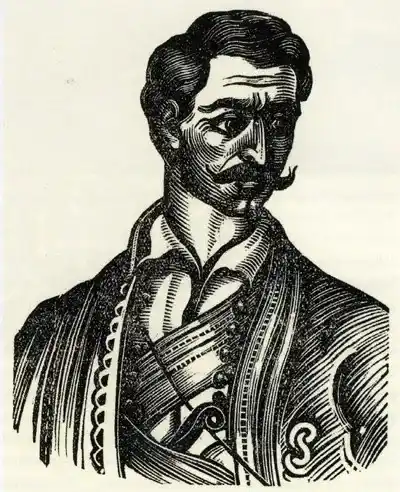
Panagiotis Anagnostopoulos
Panagiotis Anagnostopoulos was one of the most important Filiki Etaireia activists in the Peloponnese and played a decisive role in preparing the Revolution.
Panagiotis Anagnostopoulos was born in Andritsaina, Arcadia, in the late 18th century. Financial difficulties led his family to settle in Smyrna in 1808, and soon afterwards he moved to Odessa to work as a commercial clerk in the enterprises of Athanasios Sekeris from Tripoli, with the ultimate aim of supporting his family. In Odessa he became acquainted with the founders of the Filiki Etaireia—Nikolaos Skoufas, Athanasios Tsakalov and Emmanouil Xanthos. According to one account, Anagnostopoulos contributed to the conception of the idea for the creation of the secret Society; according to another, he was initiated in 1816 by Nikolaos Skoufas. What is certain is that Anagnostopoulos ranks among the most important leading members of the Filiki Etaireia, actively participating in the organisational efforts of its crucial early phase. His intelligence and his dedication to the Society’s cause led him to devote himself entirely to the expansion of the Filiki network. Among others, he initiated Athanasios Sekeris, Panagiotis Sekeris, Christos “Anagnostaras” Papageorgiou, Asimakis Krokidas and Panagiotis Dimitropoulos.
In 1819 he travelled through the Danubian Principalities, and in March 1820 he went to Italy to organise the Greek community in Pisa. He promoted the idea of establishing local Ephorates of the Filiki Etaireia in order to improve the organisation and coordination of its operations. In October 1820 he met Alexandros Ypsilantis and several senior members of the Society in Ismail, Bessarabia, where they discussed the activities of the members and the course of the forthcoming struggle. In April 1821, Anagnostopoulos and Dimitrios Ypsilantis, posing as merchants and carrying forged passports, travelled from Trieste to Hydra and from there crossed into the Peloponnese to coordinate the Revolution.
Beyond the political guidance he offered to the fighters, Anagnostopoulos also took part in military operations in the Peloponnese and Central Greece. He participated, among others, in the Siege and Fall of Tripolitsa, the Battle of Trikorfa, the Corinth Campaign, the Sieges of Nafplio and Acrocorinth, in battles in Lamia and Phthiotis, and confronted the Ottoman army at Argos during the campaigns of Dramali Pasha and Ibrahim Pasha of Egypt. He supported the government of Ioannis Kapodistrias and was appointed Governor of Elis (1829–1831) and Extraordinary Commissioner of Sparta (09/1831–03/1832). After the assassination of Kapodistrias, he continued to hold important positions in the administration of the Greek state, and his service was recognised by the regime of King Otto, which awarded him the Gold Cross of the Order of the Redeemer and the Nomismatosimon. He served as Governor of the islands of Euboea (1838) and Thera (1842), Councillor of State (1843), Governor of Laconia (1845), and Governor of Argolid–Corinthia and Messenia (1850).
He spent the last years of his life in Athens, where he died on 15 November 1854 during the cholera epidemic that struck the city.