
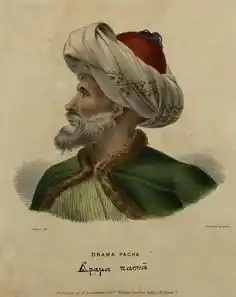
Dramalı Mahmut Paşa
Mahmud Pasha, known by the epithet “Dramalis,” was a high‑ranking Ottoman official. He served as Pasha of Thessaly and as Mora Valesi (Governor‑General) of the Peloponnese. During the Revolution he led the Ottoman campaign in Rumeli and the Morea, and was defeated at the Battle of Dervenakia by Theodoros Kolokotronis.
Mahmud Pasha, known as “Dramalis,” was born in Constantinople (according to another account, in Drama, Macedonia) around 1770, the son of Halil Mehmet Bey and Zeynep Hanım. An Ottoman official of Albanian descent and a member of the imperial elite, he received military training and took part in a series of campaigns across the Balkans.
He gained substantial military and administrative experience after his appointment in 1808 as Vali (governor) of Drama. In 1820 he was promoted to Pasha of Thessaly and assumed command of the Eyalet of Larissa, a key supply hub for Ottoman forces. From this position he confronted the local klepht‑armatoloi, acquiring further combat experience and strengthening his military capability. He distinguished himself during the 1820–1821 campaign to suppress the revolt of Ali Pasha of Ioannina, acting under the orders of Khurshid Pasha.
At the outbreak of the Greek Revolution, Dramalis Pasha was in Ioannina and moved swiftly to quell the uprisings that erupted in southeastern Thessaly in the spring and summer of 1821. By order of Sultan Mahmud II, he first advanced into Central Greece, where he faced the armed forces of Odysseas Androutsos, Nikitaras, and Demetrios Ypsilantis. Despite strong Greek resistance, he managed to cross into the Peloponnese. As serasker (military commander) of the Morea, he aimed to seize key fortified positions such as Corinth, Nafplio, and Patras. He also besieged and captured Tripolitsa, but soon encountered severe supply shortages. His oversized army—numbering roughly 35,000 men, including cavalry and artillery—could easily overpower Greek forces in open plains but proved far less effective in the mountainous terrain of the Peloponnese.
The Battle of Dervenakia, in July 1822, proved decisive for the course of the struggle in the Morea and showcased the strategic acumen of Theodoros Kolokotronis. During their retreat from Argos toward Corinth, the Ottoman forces were trapped in the narrow mountain passes of Dervenakia, allowing Greek sharpshooters to inflict heavy losses (estimated at 2,500–3,000 Ottoman dead). In the days that followed, Dramalis attempted to return to Corinth via Agionori, but was attacked by the force of Nikitaras and barely escaped with the remnants of his army. The Greeks struck again in Corinth, seeking to prevent his escape toward western Peloponnese and Central Greece. Until his death in late October 1822, Dramalis made repeated attempts to break free, all of which proved unsuccessful.