
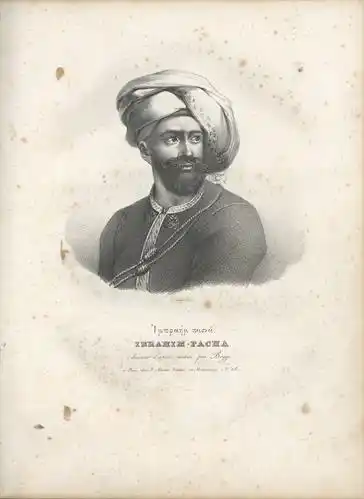
İbrahim Paşa
Ibrahim Pasha, the eldest son of Muhammad Ali Pasha, ruler of Egypt, holds a prominent place in the military history of Egypt. He led the Egyptian expedition to the Peloponnese (1824–1828) with the aim of suppressing the Greek Revolution.
Ibrahim Pasha, son of Muhammad Ali Pasha (Mehmet Ali Pasha), governor of Egypt, was born in Kavala (or, according to another account, in Drama) in 1789. One tradition holds that he was the biological child of Muhammad Ali and his first wife, Emine, while another claims he was born to a Greek Christian mother and later adopted by Muhammad Ali. Ibrahim and his siblings received military training and took part in campaigns from an early age. In 1813 he was appointed governor of Upper Egypt, and in 1816 he successfully succeeded his brother as commander of the Egyptian army in the Arabian campaign.
In 1824 Muhammad Ali agreed to assist Sultan Mahmud II in suppressing the Greek Revolution, in exchange for the governorship of the Peloponnese and Crete. Ibrahim followed his father’s orders and launched an expedition with a powerful army and fleet, first to Crete (1824) and then to the Peloponnese. On 12 February 1825 he landed at Methoni with 4,000 soldiers. In early March his forces were significantly reinforced by the arrival of approximately 7,500 additional troops. During his campaign in the Peloponnese he focused on containing the revolutionaries, seeking regular, organized engagements rather than the guerrilla warfare at which the Greeks excelled. He faced determined resistance from Greek fighters and imposed strict disciplinary measures, applying a scorched‑earth policy. His campaign involved the destruction of settlements and crops, the execution of combatants and civilians, and the enslavement of large segments of the population.
In early March 1825 Ibrahim’s army easily occupied the province of Koroni and repeatedly clashed with the forces of Ioannis and Konstantinos Mavromichalis at Niokastro. The first major Egyptian success came at the Battle of Sfaktiria in April 1825. In May followed the indecisive engagement at Dyrrachio near Megalopolis against Nikitaras, and the Battle of Maniaki. Soon afterward the Egyptians captured Kyparissia (21 May) and Kalamata (25 May), overcoming the forces of Petrobey Mavromichalis and Panagiotis Yatrakos.
Advancing toward Tripolitsa, they confronted the troops of Theodoros and Gennaios Kolokotronis, Dimitrios Plapoutas, and Kanellos Deligiannis at the Battle of Drampala (5–7 June 1825) near Akovos. Despite the determined resistance of the chieftains and the local inhabitants who joined the fight, the Egyptian army continued its march and captured Tripolitsa on 10 June 1825. Two days later the Greek forces achieved victory at the Battle of the Mills of Nafplio under Georgios Mavromichalis and Demetrios Ypsilantis. A series of engagements followed around Tripoli and at Vervena in Kynouria. In mid‑August 1825 Theodoros Kolokotronis successfully confronted Ibrahim at Trikorfa, Piana, and Zarakova in Mantineia, yet on 23 August the Egyptian forces captured Monemvasia and achieved further successes in Elis.
In January 1826 Ibrahim Pasha campaigned in Central Greece to reinforce the siege of Missolonghi, leaving Soliman Pasha “the Frenchman” in command of the Peloponnesian forces. After the heroic Exodus of Missolonghi he returned to the Peloponnese. In June 1826 the Egyptian army was defeated by the Maniots of the Mavromichalis family at Verga and Tsimo̱va (Areopoli). Further failures followed at the Battle of Mehmetaga in Tegea, at Vassaras, and at Gytheio. In the final engagements, the forces of Nikitaras (23 July 1827) and Dimitrakis Plapoutas (26–27 August 1827) played a leading role. The destruction of the Turco‑Egyptian fleet at the Battle of Navarino on 20 October 1827 led to the definitive withdrawal of the Egyptian forces from the Peloponnese and decisively contributed to the conditions that enabled the emergence of an independent Greek state.
After his campaign in Greece, Ibrahim continued his military career in the Middle East, leading major operations in Syria and Anatolia. In 1844, suffering from tuberculosis, he traveled to Italy for treatment, and in the same year succeeded his father as ruler of Egypt. He died, likely of dysentery, in November 1848.